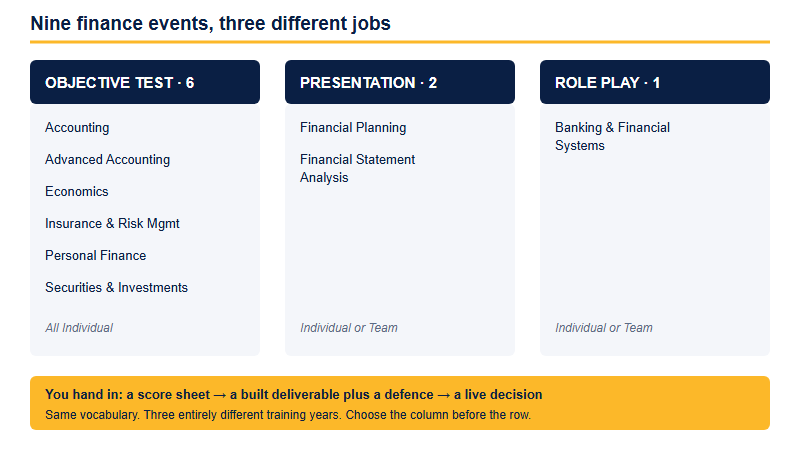
Nine events on the 2026-27 high school roster are finance events, and they are spread across three formats that ask for completely different work: six objective tests, two presentation events and one role play. The subject on the label is the same. The job is not. Pick the format first, the subject second — and use the self-check below before you commit a season to any of them.
The nine finance events, and the three jobs they ask for
FBLA lists 76 high school competitive events for 2026-27, sorted into objective tests, presentation events, role plays, chapter events and one production event. Nine of those 76 are recognisably finance and accounting. What almost nobody does is notice that those nine are not one cluster — they are three clusters wearing the same coat.
A student who is excellent at Accounting may be poorly suited to Financial Statement Analysis, even though the vocabulary overlaps almost entirely. One is a timed recall-and-apply test you sit alone. The other is a deliverable you build over months and then defend in front of judges. Treating them as interchangeable because both say “financial” is the single most common way students in this cluster waste a season.
| Event | Format | Entry | What the format actually asks of you |
|---|---|---|---|
| Accounting | Objective Test | Individual | Recall and apply core accounting treatment at speed, alone, against a clock |
| Advanced Accounting | Objective Test | Individual | The same job at a higher difficulty ceiling — read the competency list before assuming it is just “harder” |
| Economics | Objective Test | Individual | Micro and macro reasoning applied to short scenario items |
| Insurance & Risk Management | Objective Test | Individual | A specialist domain few school curricula cover — expect steep private reading |
| Personal Finance | Objective Test | Individual | Household-level financial decisions; the most accessible entry point in the cluster |
| Securities & Investments | Objective Test | Individual | Markets, instruments and portfolio concepts |
| Financial Planning | Presentation | Individual or Team | Build something over months, then stand up and defend the reasoning behind it |
| Financial Statement Analysis | Presentation | Individual or Team | Interpretation, not arithmetic — the judge wants your conclusion and your evidence for it |
| Banking & Financial Systems | Role Play | Individual or Team | Read a case cold, decide, and justify the decision live under time pressure |
Business Law sits on the edge of this cluster as a seventh objective test — close enough that finance-minded students should look at it, far enough that we have not counted it above.
Read one guideline end to end before you choose
Every competitive event publishes its own guideline document, and that document — not a forum post, not a summary like this one — is the authority on your event. The habit worth building in September is reading one from top to bottom so you know what the fields mean.
We read the 2026-27 Data Science & AI guideline end to end purely to show the shape of the document. It is not a finance event, and this is deliberate: the point is the structure, not the numbers. That guideline states the event is Individual, that it is a 50-minute test of 100 multiple-choice questions, that each correct answer is worth one point with no deduction for incorrect answers, and it sets out a three-stage tie-break — 10 pre-selected tie-break questions first, then 20 pre-selected questions, then the shorter completion time.
Do not carry a single one of those numbers across to Accounting or Personal Finance. Question counts, time limits and tie-break rules are printed per event and can differ. Borrowing a sibling event’s numbers is exactly how students end up pacing for the wrong test. Open your own event’s guideline on fbla.org and fill in these six fields yourself:
- Entry type — individual only, or individual or team?
- Grade eligibility — is the event open to you this year?
- Length and clock — how many items, how many minutes, giving you what pace per item?
- Scoring — is there any deduction for a wrong answer, or is a blank strictly worse than a guess?
- Tie-break — what separates two identical scores, and does completion speed enter it?
- Eligibility conditions — the membership, registration and conference conditions printed alongside the competitive rules.
That last field is the one students skip and advisers lose sleep over. Guidelines carry conditions that have nothing to do with your performance — dues paid by a stated deadline in Eastern Time, being properly registered for the conference, and conference housing requirements among them. They decide whether a result counts at all. Read them on your own event’s page, and check how the qualification path actually works before you assume the route to nationals.
The format-fit self-check
Score yourself honestly. One point for every statement that is true of you in a normal school week — not the version of you that exists in a plan.
| # | Statement | Points to |
|---|---|---|
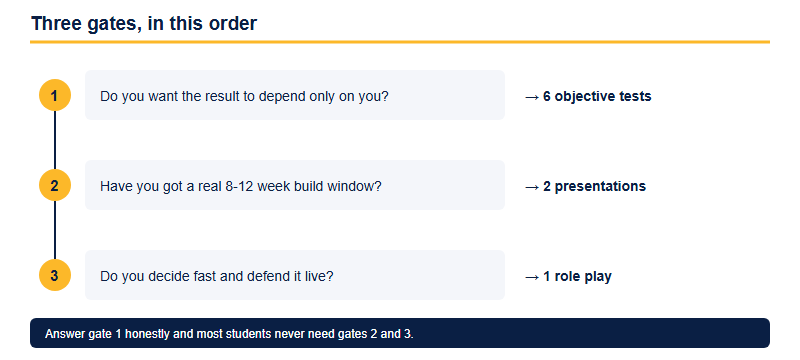
| 1 | I would rather be judged by a number than by a person | Objective test |
| 2 | I can hold accuracy when a clock is visibly running down | Objective test |
| 3 | I can study alone for 45 minutes without external structure | Objective test |
| 4 | I already have, or can get, a source of practice questions and a way to review my errors | Objective test |
| 5 | I finish long projects that nobody is chasing me about | Presentation |
| 6 | I can explain a conclusion out loud to a stranger who is allowed to interrupt me | Presentation |
| 7 | I have a realistic 8-12 week window in my calendar to build something | Presentation |
| 8 | I make decisions faster than I make them perfect | Role play |
| 9 | I have one teammate I would trust in a room where we cannot confer freely | Role play |
| 10 | I am comfortable being wrong out loud and defending the reasoning anyway | Role play |
Reading your score. Count the points inside each block, not the total.
- 3-4 of statements 1-4: the six objective tests are your natural column. Start with Personal Finance or Economics if you are new to the cluster; Advanced Accounting is not a beginner’s event.
- 2-3 of statements 5-7: Financial Planning or Financial Statement Analysis will reward you — but only if statement 7 is genuinely true. A presentation event without a real build window becomes a scramble that judges can see.
- 2-3 of statements 8-10: Banking & Financial Systems suits you. This is the only role play in the finance cluster, and it is a different sport.
- Fewer than 2 in every block: that is useful information, not a failure. Take an objective test this season to build the vocabulary base, and revisit the judged formats next year with a subject you already own.
What “finance” actually means inside each format
The word changes meaning as you move across the columns, and this is where students who transfer in from a strong maths background get surprised.
In the objective tests, finance means recognition and application at speed. You are not deriving anything elegant. You are recognising which treatment, ratio or definition a short item is pointing at, and doing it inside a per-item budget that leaves no room for rediscovering ideas from first principles. Arithmetic ability is necessary and nowhere near sufficient; vocabulary command is what separates scores, which is why the terminology work pays off across every event in this column.
In the presentation events, finance means interpretation. Financial Statement Analysis in particular is misread by strong maths students as a computation exercise. Computing a ratio is the easy half; the scored half is what you claim the ratio means, what evidence you bring, and whether you survive the judge asking why the other reading is wrong. A student who calculates flawlessly and concludes nothing does not place.
In the role play, finance means defensible judgement under time pressure. Banking & Financial Systems hands you a situation and wants a decision plus reasons. There is rarely one correct answer and always a range of indefensible ones.
For students competing from a China campus, the presentation and role play columns carry a specific extra load: your judge may not know your local market context, and unexplained local references cost you points that have nothing to do with your finance reasoning. Our own coaching experience is that this is the most common avoidable score leak for China-based competitors in judged finance events — the analysis is sound and the orientation is missing. The international students guide covers the mechanics of competing from outside the US in more detail.
Stacking the cluster across two seasons
The nine events reward sequencing far more than they reward ambition. A workable two-season shape inside this cluster looks like this:
- Season one — build the vocabulary base. Take one objective test in the cluster. In our own coaching experience Personal Finance and Economics are the most forgiving entry points, because the underlying content overlaps with school courses more than Insurance & Risk Management or Securities & Investments do. You learn the terminology, you learn how the testing format feels, and you finish the year with a subject you actually own.
- Season two — convert command into a judged result. Move the same subject into a judged format: Financial Statement Analysis or Financial Planning if you build well, Banking & Financial Systems if you think fast. You are no longer learning finance and learning a format simultaneously, which is the trap that sinks first-year students who start in a presentation event.
Two structural notes before you plan. First, entry rules cap what you can enter, so the plan above is one event per season, not a portfolio. Second, the roster is reissued every year: events are added, retired and renamed, so a two-season plan must be re-checked against the current list each August-September rather than assumed forward. The full competitive events guide is the place to see how this cluster sits inside the whole roster.
On the admissions side, be realistic about what a finance result does and does not do. A placement in Accounting or Financial Statement Analysis is read alongside the rest of your file — an admissions reader checks it against your transcript, your activity list and your essays. A finance award that sits next to strong quantitative coursework and an essay that shows genuine interest in how businesses are measured corroborates a coherent story. The same award attached to a file with no supporting evidence anywhere else does much less work, because there is nothing for it to cross-validate against. Build the rest of the file, and the result confirms something true.
Questions students ask about the finance cluster
Is Advanced Accounting just a harder version of Accounting?
Treat them as separate events with separate competency lists. Read both guidelines on fbla.org before assuming one is a step up from the other.
Which finance event is easiest to place in?
Nobody publishes field sizes by event, so any ranking of difficulty is guesswork. Choose on format fit and subject command instead.
Can I enter two finance events in one season?
Entry limits cap how many events you may enter and are reissued yearly. Check the current rules on fbla.org before planning two.
Do I need accounting coursework before entering Accounting?
Not formally, but the competency list assumes real content knowledge. If your school teaches no accounting, budget private study time honestly.
Published by the FBLA editorial desk, operated by Hanlin Education for China-based international-school students. Official rules are set by the competition and change yearly — confirm current details on fbla.org. Errors are corrected within 7 working days of notice.