FBLA reviews and re-issues its national Competitive Event Guidelines every year, and states it releases the updated set by 1 September. That means the event you trained on in August may be renamed, merged, moved to another division, or retired before the season formally opens. The fix is not to stop preparing in August — it is to prepare the parts that survive a rewrite.
What actually resets, and when
According to FBLA’s published guidelines review process, all national Competitive Event Guidelines are reviewed and updated annually by the Competitive Events Committee, and edits reflect alignment with educational standards, industry feedback, event performance data, and input from advisers and state leaders. FBLA has said the updated guidelines are released by 1 September each year, with the 2026–27 guidelines — including topics — expected to be live at the beginning of September. Confirm the exact posting date on fbla.org before you build a plan around it.
For a China-based student this is a bigger deal than it is for a US student sitting in a business classroom. Your adviser in a US school hears about changes in a state adviser meeting; you are more likely to be self-directing from a Chinese international school where FBLA is one club among many. If you spend July and August rehearsing an event that quietly disappeared in the May change list, nobody rings you to tell you.
Here is the practical shape of the year. Notice that the two months most international students actually have free — July and August — sit before the guidelines drop, not after.
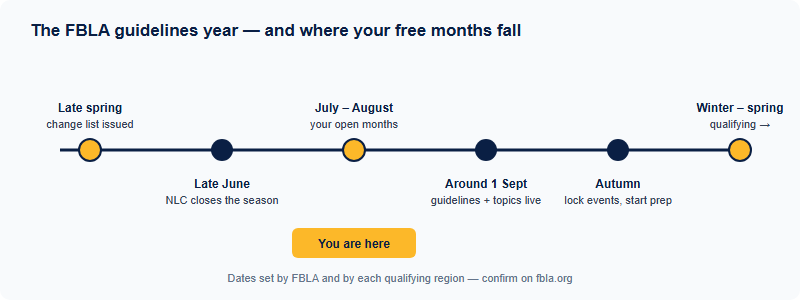
The four kinds of change, and what each one costs you
Not all edits hurt equally. A rubric tweak costs you an afternoon; a retirement costs you a summer. The most recent published high-school change list — the one FBLA issued for the 2025–26 season — is a useful worked example of all four types at once.
| Change type | Example from FBLA’s 2025–26 high school change list | What it costs a student who missed it |
|---|---|---|
| Retirement | Word Processing was retired | Everything. A whole summer of typing drills with no event to enter. |
| Merger / absorption | Spreadsheet Applications was retired and its content included in Computer Applications | Little, if you notice. Your skill still counts, but the test scope widens — you now have to cover the rest of Computer Applications too. |
| Division move | Spreadsheet Applications and Word Processing moved to the Middle School division | Total, if you are in high school. The event exists — just not for you. |
| Reframing into another format | UX Design was retired, with UX Design treated as a skill to be showcased inside presentation events such as Coding & Programming | Half. Your subject knowledge transfers; your event format does not. You now need presentation skills you may not have trained. |
| Scope modification | Supply Chain Management was modified into a team event using the Presentation with a Topic format, extending the Supply Chain career pathway | Usually an opportunity — but note it now runs as a team presentation, so you need teammates and rehearsal time, not just topic knowledge. |
Read the pattern rather than the specific rows. Several of the changes above moved skills from a standalone testable event into a presentation or a broader test. That is the direction FBLA has been signalling: narrow software events consolidate; the ability to explain and apply a skill in front of judges survives. If you are choosing where to invest a summer, that direction matters more than any single event name. Our complete guide to the FBLA competitive events maps the 76+ events by format so you can see which clusters are structurally stable and which are candidates for consolidation.
Guideline-proof preparation: what to actually build in August
Split your August into two buckets. Bucket one is work that keeps its value no matter what the 1 September release says. Bucket two is work that is only safe once you have the new guidelines in hand. Do bucket one now; queue bucket two.
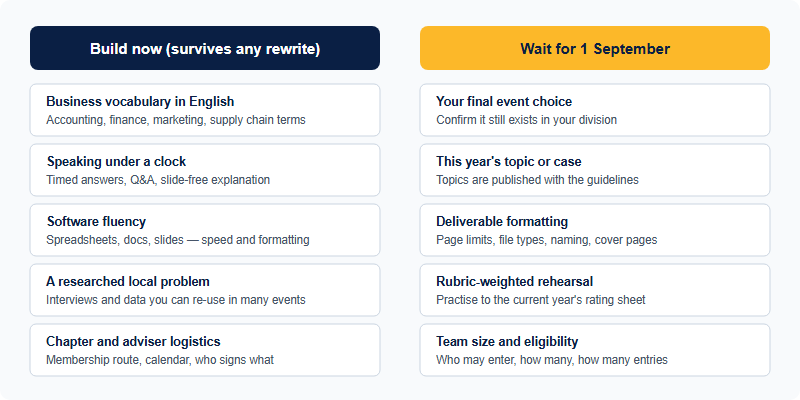
The asymmetry is the whole point. Everything in the left column would still have been useful to a student whose event was retired — vocabulary, timed speaking, spreadsheet speed and a researched local problem all transfer to whatever event they picked instead. Everything in the right column would have been thrown away.
A hedged August plan: prepare a cluster, not an event
The single most useful habit is to commit to a format family in August and defer the specific event to September. Formats change far more slowly than event names. Objective tests, prejudged reports, production tests, role plays and presentations have all persisted through multiple rewrites, even as individual events inside them were merged or retired.
- Pick two adjacent events, not one. If your first choice is retired or moved, your second choice inside the same format needs almost no retraining. A student prepping Accounting-style objective tests can pivot inside the objective-test family in a week; a student prepping a single niche software event cannot pivot at all.
- Write your evidence base before you know the topic. Interviews with a local business owner, a small dataset you collected yourself, or a documented problem at your school will slot into a business plan, a chapter project, a presentation or a case response. Collect it in August; frame it in September.
- Build the English, not the script. Memorised scripts die when the topic changes. Timed practice at explaining a business idea in three minutes survives everything.
- Do not buy or build materials pegged to a retired event. Check the current-year guidelines before spending money on any prep pack, and treat any material that does not name the current season as suspect.
Students competing from outside the United States have one extra constraint worth planning around: your qualifying route and travel decisions have longer lead times than an American student’s. Read our guide to how FBLA works for international students alongside the guidelines when they land, and check the qualification mechanics in how to qualify for the National Leadership Conference before you fix your event.
Your first-week-of-September checklist
When the new guidelines appear, run this in one sitting. It takes about ninety minutes and it is the highest-leverage ninety minutes of your season.
- Confirm the event still exists for your division. High school and middle school catalogues are not identical, and events have moved between them — cross-check the new guidelines against our FBLA competition format and rules page before you commit.
- Diff the guideline against last year’s. Read the current guideline top to bottom and note every number: time limits, team size, page or slide limits, whether notes are allowed, whether a device is permitted.
- Copy the rating sheet into your own document. Turn each scored line into a checklist item. You are going to rehearse against this, not against a general idea of “being good”.
- Note every deadline that is not the conference date. Prejudged uploads, statements, and registration steps usually close well before you compete, and they are set in local US time zones — convert them to China Standard Time and put them in your calendar with a 72-hour buffer.
- Re-run your two-event hedge. With the real catalogue in front of you, confirm your primary event and keep one same-format backup.
One last framing note for this particular year. NLC 2026 in San Antonio has already been held; the season now opening builds toward NLC 2027, which FBLA’s published 2026–27 schedule puts on 23–26 June 2027 in Columbus, Ohio — early enough to price flights and start visa planning now. Confirm on fbla.org before you commit money, and do not budget around a date you have only seen on a third-party site.
Frequently asked questions
When exactly do the 2026–27 FBLA competitive event guidelines come out?
FBLA states it releases updated guidelines by 1 September each year, with topics included. Confirm the current posting date on fbla.org.
Can my event really be removed after I have prepared for it?
Yes. FBLA’s last published high-school change list retired several events outright and moved others to the Middle School division.
Is it pointless to prepare in July and August?
No. Vocabulary, timed speaking, software speed and your own research data transfer to any event. Only topic-specific and format-specific work should wait.
Where do I find what changed this year?
FBLA publishes the updated guidelines and, in recent years, a separate change summary for the high school division. Both live on fbla.org.
Published by the FBLA editorial desk, operated by Hanlin Education for China-based international-school students. Official rules are set by the competition and change yearly — confirm current details on fbla.org. Errors reported to the editorial desk are corrected within 7 working days.