FBLA (Future Business Leaders of America) has operated authorized chapter activity in China since 2015, with active chapters across leading international high schools in Shanghai, Shenzhen, Beijing, Qingdao, and other cities. International students participate through the same chapter-based structure as US members, qualifying through regional or country-level competitions before advancing to the US National Leadership Conference (NLC) held each summer. This guide walks through the FBLA China structure, the chapter membership path, the schools already running successful programs, NLC travel logistics for non-US participants, and the common mistakes first-year international chapters make.
Quick Facts
| FBLA China authorization | 2015 — FBLA China is the authorized coordinating office of FBLA in China |
| Global footprint | 47 US states + Canada + China + Europe + Central/South America (per fbla.org) |
| Total membership | Over 6,400 member schools and 250,000+ students worldwide |
| Grade eligibility | FBLA High School: grades 9-12 · FBLA Middle School: grades 5-9 |
| National membership deadline | March 1 of the current school year — required to compete at NLC (per fbla.org) |
| 2026 NLC | June 29 – July 2, 2026 at the Henry B. González Convention Center, San Antonio, TX |
| Chapter requirement | Business teacher adviser + minimum 5 active student members |
| Travel documentation | U.S. B1/B2 visitor visa for non-US citizens attending NLC |
FBLA China: The Eleven-Year Operating Record
FBLA’s expansion into China began in 2015 when FBLA national authorized FBLA China as its coordinating office in the country. Over the eleven years since, the program has grown from a handful of pioneer chapters in tier-1 cities to a network spanning international divisions of public high schools, foreign-owned international schools, and bilingual academies across at least a dozen Chinese cities. The official social presence at @fbla_china documents annual chapter activities and national competition results.
For Chinese international high school students, FBLA serves a different strategic function than for the average American high schooler. In US schools, FBLA is one of dozens of student organizations available; in Chinese international schools, it is often the highest-quality business-track extracurricular available, and the only one with direct recognition by US college admissions officers who already know the FBLA brand. This is why a Chinese student’s FBLA achievement — even at the regional level — tends to carry disproportionate weight in admissions readers’ evaluations relative to an equivalent US student’s same achievement.
The Chapter Membership Path: Six Steps
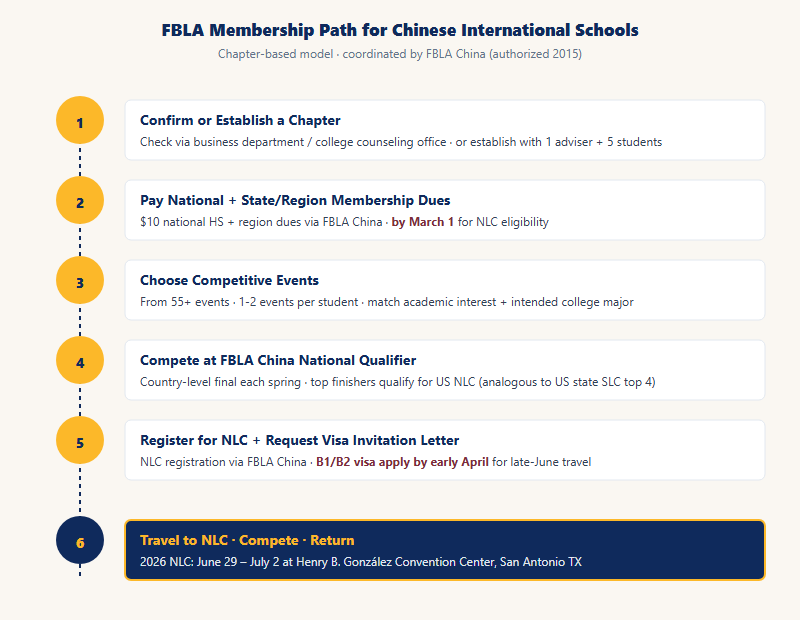
Joining FBLA from a Chinese international school follows a chapter-based model identical in structure to US membership, with localized administration through FBLA China:
Step 1 · Confirm or Establish a Chapter
Check whether your school already has an active FBLA chapter through your business department, college counseling office, or activities office. If a chapter exists, contact the current officer team for the joining process — usually a brief application or interest meeting. If no chapter exists, the school can establish one with a business teacher (or another faculty member with relevant background) serving as adviser, plus a minimum of five interested students.
Step 2 · Pay National Membership Dues
National membership dues are paid annually through FBLA Connect (the national portal) by the published deadline. Per FBLA national policy, dues for the current school year must be paid by March 1 to be eligible for NLC competition. State or region-level dues (administered through FBLA China for international chapters) are separate and additional. Chapter advisers handle the payment workflow centrally rather than each student paying individually.
Step 3 · Choose Competitive Events
FBLA’s 2025-2026 Competitive Events catalog includes 55+ events across business, finance, communications, technology, and emerging STEM domains (including a recently expanded Data Science & AI track). Most students compete in 1-3 events. Event selection should align with each student’s intended major: prospective finance applicants gravitate toward Accounting, Banking & Financial Systems, and Business Finance; computer science applicants toward Coding & Programming or Cyber Security; entrepreneurship-track students toward Business Plan and Entrepreneurship.
Step 4 · Compete at the Country / Region Level
FBLA China runs its own national-level qualifying competition each spring (analogous to the US State Leadership Conference). Top finishers at the China-level final qualify for the US NLC, following the same advancement logic as US state qualifiers. Past China-level finals have included formal pre-judged competitions, on-site presentations, and judged Q&A sessions parallel to US conference formats.
Step 5 · Register for NLC
Qualifying students register for NLC through their FBLA China adviser. NLC registration includes the conference fee plus hotel block placement (FBLA negotiates official rates at properties near the convention venue). International chapters should request a formal letter of invitation from FBLA national to support the U.S. visa application process.
Step 6 · Travel, Compete, and Return
Detailed travel and on-site logistics — daily schedule, dress code, packing list, day-of survival rules — are documented in our companion article on FBLA NLC 2026 San Antonio.
Chinese International Schools Active in FBLA
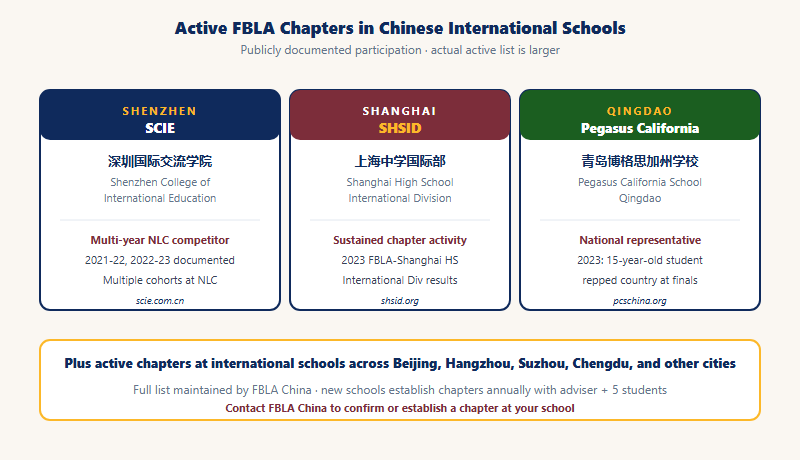
A non-exhaustive list of schools whose FBLA participation is publicly documented through school websites, FBLA national announcements, or chapter social channels:
- Shenzhen College of International Education (SCIE / 深国交) — one of the earliest Chinese international schools to participate in FBLA-China competitions, with multiple cohorts qualifying for and competing at US NLC. SCIE’s own website documents 2021-22 and 2022-23 FBLA results.
- Shanghai High School International Division (SHSID / 上海中学国际部) — published reporting on FBLA Shanghai High School International Division performance documents sustained chapter activity and national-level competitive results.
- Pegasus California School Qingdao (青岛博格思加州学校) — documented case of a 15-year-old student representing China in international FBLA competition.
The actual active-chapter list is larger than the above publicly-documented sample. Any Chinese international high school with an active business or economics department can establish a chapter; the formal path runs through FBLA China rather than direct US FBLA national contact.
What Is Different for Chinese Chapters vs. US Chapters
1. Competition Path Structure
US students compete in chapter → regional → state → national (four levels typically). Chinese chapters compete in chapter → FBLA China national qualifier → US NLC (three levels). The compression means qualifying for NLC from China requires winning the China-level final — statistically more selective than placing top-4 at a US state conference because the China qualifier pool is the entire country, not a single state.
2. The Dues and Registration Workflow
US chapters typically interact directly with their state FBLA office for everything from dues to NLC registration. Chinese chapters interact with FBLA China as the centralized intermediary. The added layer is occasionally a source of delays; the practical adaptation is to start dues processing in January (rather than the US-typical February) to ensure the March 1 national deadline is met.
3. Travel and Documentation Lead Time
A US student attending NLC needs a hotel reservation and a plane ticket — both are bookable in May or June. A Chinese student needs a valid U.S. visa, which in many consular districts requires a 60-90 day lead time from interview booking to visa issuance. Apply for the B1/B2 visa no later than early April for late-June travel. The official FBLA letter of invitation should be requested 30 days before the visa interview.
4. Currency and Logistics During Travel
Bring a credit card with zero foreign transaction fees (Chase Sapphire Preferred, Capital One Venture, and several Chinese-issued international cards are common choices). U.S. card acceptance is universal at the convention center and FBLA-affiliated hotels; cash usage is minimal. Hotel deposit holds on debit cards can tie up funds for 7-10 days after check-out, so use a credit card for the room booking when possible.
5. The Adviser Workload
A Chinese chapter adviser absorbs more administrative load than a US counterpart: dues coordination through FBLA China, visa support documentation for the entire chapter, group flight booking, and emergency contact protocols for parents 12-15 time zones away. Choose the adviser carefully — chapter performance correlates strongly with adviser availability during the February-June stretch.
Practical Cost and Timeline Snapshot
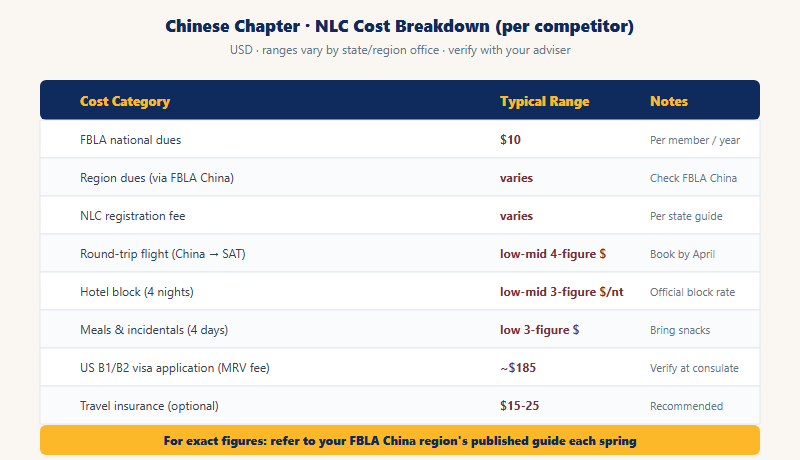
Direct chapter and national membership dues are a small fraction of total program cost for Chinese participants. The dominant cost categories are travel and accommodation for NLC:
| Cost category | Typical range per competitor (USD) | Notes |
|---|---|---|
| National FBLA membership dues | Modest; published annually by FBLA national | Paid by chapter; per-student share is small |
| FBLA China region-level fees | Varies by region; check FBLA China | Includes regional competition entry |
| NLC registration fee | Refer to your state/region’s published guide | Confirmed annually; varies by region |
| Round-trip flight (China → SAT) | Low to mid four-figure USD range | Book by April for late-June travel |
| Hotel block (4 nights) | Low to mid three-figure USD per night | Official block; private booking is more expensive |
| Meals and incidentals (4 days) | Low three-figure USD | Convention center food is expensive; bring snacks |
| U.S. visa application fee | ~$185 USD (current MRV fee) | Verify with the U.S. embassy/consulate at time of application |
For exact figures, refer to your FBLA China region’s published registration guide; we deliberately do not publish region-specific fee numbers here because they update annually and inaccurate numbers cause more confusion than they prevent.
Common Mistakes First-Year Chinese Chapters Make
Patterns observed across multiple first-year Chinese chapters that did not advance to NLC, contrasted with patterns of chapters that did:
1. Treating FBLA as a single-event sprint instead of a year-long program
High-performing Chinese chapters begin competitive event preparation in September-October, not March. The events that win — Business Plan, Sales Presentation, Future Business Leader — require months of preparation, not weeks. Chapters that start in February consistently underperform chapters that started in October even when their members are individually more capable.
2. Choosing too many events per student
A first-year competitor performing one event well outranks the same student performing three events at 70% quality. Successful first-year Chinese chapters typically have each member compete in one primary event plus one secondary/team event, not three or more.
3. Underestimating the time-zone factor
A 12-15 hour time difference between China and Texas means competitors who land on June 29 morning are operating on essentially zero sleep when the Opening General Session starts that evening. Arrive Saturday June 27 or Sunday June 28; the cost of the extra hotel night is recouped in scoring across four days of competition.
4. Treating the dress code as US-fashion
U.S. “business professional” dress norms differ subtly from the formal-meeting dress norms common in Chinese workplaces. Suits should be conservative in cut and color (navy, charcoal, black); a tie that reads “fashionable” in Shanghai may read “distracting” to a Wisconsin-based judge. Default to conservative; you cannot lose points for being too plain.
5. Skipping mock judging with non-Chinese-speaking judges
Chinese chapter members often practice their presentation only with their adviser and chapter peers — all of whom are native or near-native Chinese speakers. NLC judges are American; their listening calibration is set to American English pronunciation, pacing, and idiom. Practice with at least one mock judge who is not a Chinese speaker, ideally an American teacher or alumnus, before NLC.
Hanlin chapters at FBLA China: a recent track record
In the 2023–24 FBLA China season, Hanlin teams placed #1 nationally in Marketing, with 3 students winning national gold and advancing to the global NLC. In 2022–23, Hanlin reached national Top-2 in Business Ethics and Sports & Entertainment Management, and across recent seasons students have earned 20+ Leadership Conference invitations per year — including a global runner-up in Business Financial Plan, the first Chinese students to reach that event’s global top three. (Hanlin internal data.)
Frequently Asked Questions
When did FBLA officially start operating in China?
FBLA national authorized FBLA China as its coordinating office in 2015. Over the eleven years since, FBLA China has supported chapter establishment across leading Chinese international high schools, with active chapters now spanning at least a dozen cities including Shanghai, Shenzhen, Beijing, Qingdao, and others.
Can a Chinese student join FBLA if their school does not have a chapter?
A new chapter can be established with a business teacher (or other faculty member with relevant background) serving as adviser plus a minimum of five interested students. The chapter establishment process runs through FBLA China rather than direct contact with FBLA US. Students at schools without a chapter cannot register as individuals — FBLA membership is chapter-based by design.
What is the deadline to pay FBLA dues if I want to compete at NLC?
Per FBLA national policy, national membership dues for the current school year must be paid by March 1 to be eligible for NLC competition. Chinese chapters should start the dues processing workflow in January to allow buffer time for FBLA China’s centralized administration.
Do Chinese students need a US visa to attend FBLA NLC?
Yes — non-US citizens require a valid U.S. visitor visa (typically B1/B2) to enter the United States for NLC. Apply 60-90 days before NLC. Request a formal letter of invitation from FBLA national through your adviser to support the visa application.
How are Chinese competitors evaluated differently from US competitors at NLC?
They are not. NLC competitive events use a uniform rubric for all competitors regardless of country of origin. Chinese students are judged on the same scoring criteria as US students. The only differences are administrative (which state/region office handles the registration paperwork) rather than evaluative.
Which Chinese international schools are most active in FBLA?
Publicly documented active participants include Shenzhen College of International Education (SCIE), Shanghai High School International Division (SHSID), and Pegasus California School Qingdao. The actual list of active Chinese chapters is larger than this publicly documented sample; the comprehensive list is maintained by FBLA China.
Can a Chinese student compete in any FBLA competitive event, or are some events restricted?
All FBLA competitive events are open to international students; there are no nationality-based restrictions. Some events (such as Public Speaking I, Sales Presentation, Job Interview) advantage strong English-language fluency; events that are more analytical (Accounting, Cyber Security, Data Science, Business Law objective tests) are less language-dependent. International students should choose events that match both their academic strength and their English fluency.
Related Resources
- 📅 NLC logistics → FBLA NLC 2026 San Antonio: Schedule, Hotels & What to Pack
- 🏛️ Conference overview → FBLA National Leadership Conferences
- 📋 Competition rules → FBLA Competition Format & Rules
- ✍️ Registration walkthrough → FBLA Registration · How to Join the Business Competition
- 🌍 International chapter resources → FBLA for International Students
- 📞 Connect with our editorial desk → Contact
This guide synthesizes information from fbla.org, FBLA China’s documented chapter activity, and the published competition records of Chinese international schools listed above. For chapter-specific guidance, contact our editorial desk through the Contact page.